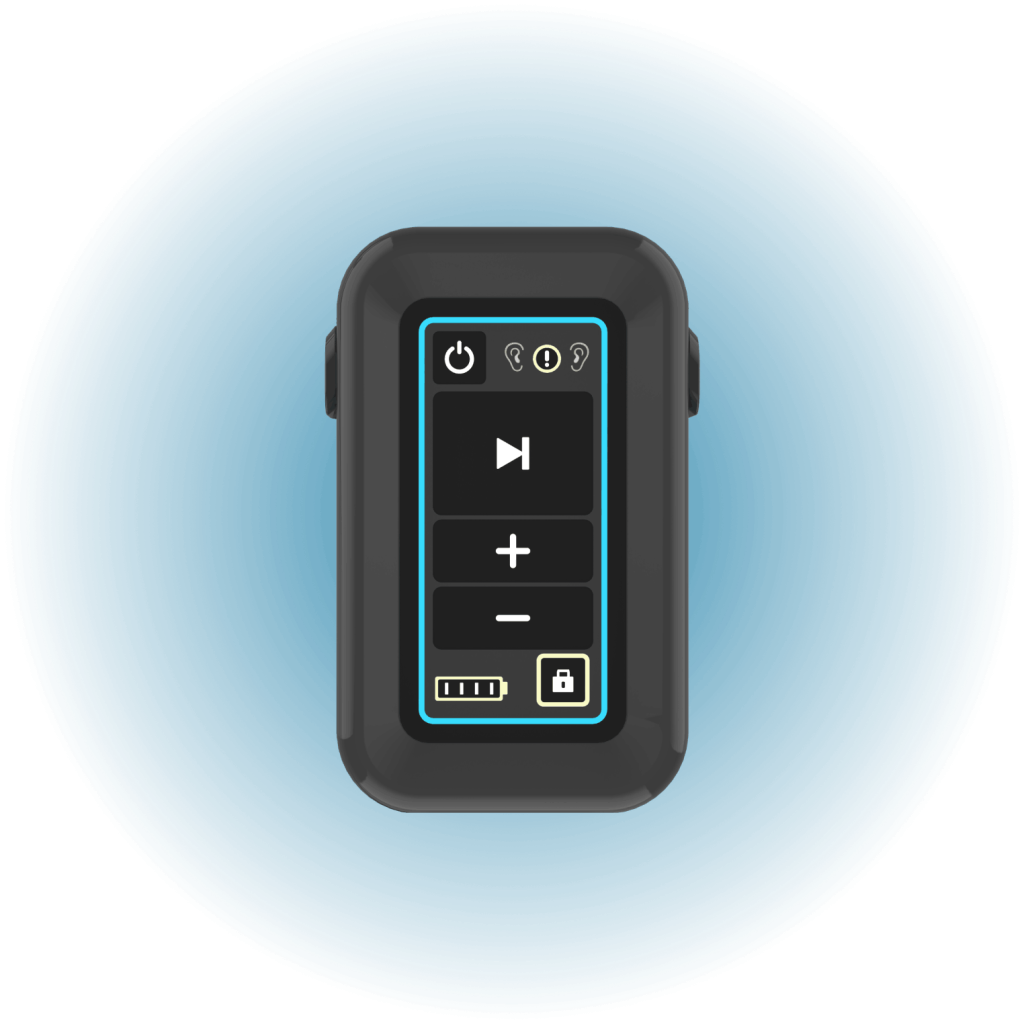
Introducing the only non-invasive vagus nerve stimulation approved as a Class IIa medical device under the EU-MDR.
We, tVNS® Technologies GmbH, are pioneers in the field of transcutaneous, non-invasive vagus nerve stimulation. Our product portfolio includes:
Currently, the only transcutaneous, non-invasive vagus nerve stimulation device approved in Europe under the new Medical Device Regulation (MDR EU 2017/745).
Our tVNS® R device offers complete wireless programmability for comprehensive clinical studies. With the tVNS® Research and tVNS® Connect apps, stimulation parameters can be adjusted, data collected, and patient feedback recorded. In addition, our tVNS® Triggerbox provides a wired system that reproducibly reduces and stabilises latency and fluctuations. This enables closed-loop tVNS® or triggered tVNS® to be realised within a scientific research setup.
All of our tVNS® devices are supplied as standard with legacy electrodes and all required accessories.
Our tVNS® R device offers complete wireless programmability for comprehensive clinical studies. With the tVNS® Research and tVNS® Connect apps, stimulation parameters can be adjusted, data can be collected, and patient feedback can be recorded.
To support clinical studies, we also provide a comprehensive CB safety report for ethics committee approvals, as well as access to a global network of experts.
With the tVNS® Research App, you can wirelessly configure a wide range of parameters, including frequency, pulse width, current intensity and stimulation intervals.
In addition, we offer separate PC-based tVNS® Manager software. This software enables responses to external trigger signals, such as ECG R-wave triggers detected by an external ECG system, transmitted to a PC, and used to trigger tVNS® stimulation. This makes it possible to realise closed-loop tVNS® or triggered tVNS® within a scientific research setup.
Until now, coupling with external trigger signals was only possible via Bluetooth. Bluetooth transmission of trigger signals is subject to latency and jitter. This makes it more difficult to establish robust experimental setups.
Over recent years, several research groups have repeatedly asked us how latency and jitter could be reduced to enable even more precise and reproducible closed-loop research protocols. Our solution is the tVNS® Triggerbox.
The tVNS® Triggerbox comes with an easy-to-use tVNS® API interface that significantly improves usability. The combination of the tVNS® Triggerbox and the new tVNS® API Server software ensures more precise tVNS® stimulation triggering. This allows the different components of the experimental setup to be aligned more accurately. Ultimately, the tVNS® Triggerbox enables more stable and reproducible stimulation protocols.
With your tVNS® R device, you have access to the tVNS® Research and tVNS® Connect apps. With the tVNS® Research App, all technical parameters can be easily reprogrammed and transferred wirelessly, allowing researchers to test entirely new stimulation protocols.
If desired, technical data and patient feedback can also be collected and stored. When synchronised with the stimulator, the tVNS® Connect App visualises and stores all technical data, including stimulation parameters, time and duration of stimulation, and provides a questionnaire for patient feedback.
We offer individual adaptation of all device components for specific studies, for example, by modifying the questionnaire to improve user feedback, or by implementing specific stimulation parameters or other technical requirements.
We can provide a CB report demonstrating safety in accordance with the relevant regulatory standards for medical devices to support ethics approval processes. So far, all ethics applications for studies using our devices have been approved by the responsible committees.
In addition, we offer access to an international network of experts and can forward questions to experienced specialists worldwide.
We offer two ear electrodes.
Our so-called Legacy electrode is supplied as standard. For around 90% of our customers, this electrode has proven to be the better fit. This is partly because it offers several adjustment options, including a silicone ring available in different sizes and an electrode holder that can be adapted to the size of the ear.
The Legacy electrode is suitable for an average ear, but is particularly well-suited to small ears and unusual ear shapes.
The Hook electrode, on the other hand, runs in a hook shape around the base of the auricle and can be worn with headphones and hearing aids. However, if the user wishes to move during stimulation, we generally recommend the Legacy electrode.
In pursuit of scientific accuracy and integrity, we offer several options for sham stimulation in double-blind studies. The well-known sham stimulation at the earlobe remains possible. On request, we can also support research teams with more advanced sham stimulation options.
Our fMRI-compatible electrodes also enable MRI studies in tVNS® research.